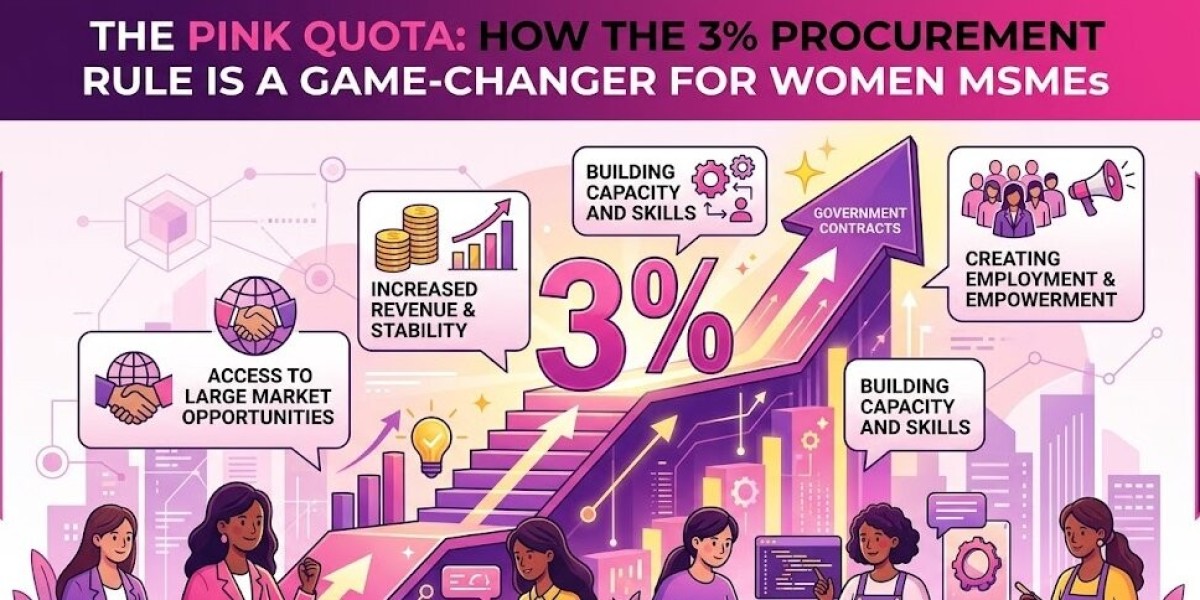

In Indian business we often say that the market is neutral for everyone. But let’s be honest: female entrepreneurs often face more challenges from accessing credit to breaking into traditional supply chains. So to create equal opportunities for everyone, the government of India has introduced a powerhouse policy with udyam registration: the 3% Public Procurement Quota.
1. What is the 3% Procurement Quota?
Under the Public Procurement Policy for MSEs, every Central Ministry, Department, and Central Public Sector Enterprise (CPSE) is mandated to source at least 25% of their annual requirement from Micro and Small Enterprises.
Within this 25%, a specific 3% is reserved exclusively for women-owned MSEs.
What does "Women-Owned" mean? > For a company to qualify, a woman (or women) must hold at least 51% shareholding and controlling interest. In the case of a proprietorship, the proprietor must be a woman.
2. Beyond the 3%: Exclusive Schemes for 2026
While the quota gets you the "order," other schemes ensure you have the "capital" and "skills" to fulfill it.
The "Yashasvini" Campaign: Launched to provide a "continuum of support," this campaign offers mentorship and capacity building specifically to help women-led MSMEs transition from local shops to government suppliers.
Enhanced CGTMSE Coverage: While standard businesses get 75% guarantee coverage, women-owned MSEs get 90% guarantee coverage on collateral-free loans. Plus, you get a 10% concession on annual guarantee fees.
PMEGP Subsidy Boost: Under the Prime Minister’s Employment Generation Programme, women are classified as a "Special Category." This means you can get a 35% subsidy in rural areas (vs. 25% for general) and 25% in urban areas.
100% Export Subsidy: If you participate in international trade fairs under the Procurement and Marketing Support (PMS) scheme, the government subsidizes 100% of the space rent and airfare for women, compared to 80% for others.
3. How to Claim Your Reservation
The benefits don't apply automatically. You need to have these documents
Udyam Registration: This is your primary identity. Ensure your Udyam certificate clearly reflects woman-ownership.
GeM (Government e-Marketplace) Onboarding: Most of the 3% quota is fulfilled through GeM. The portal automatically "flags" women-owned businesses, making you visible to government buyers who are looking to meet their 3% target.
Tender Exemptions: As a registered MSE, you are exempt from paying Earnest Money Deposit (EMD). This keeps your cash flow healthy even when bidding for large contracts.
How to Recover your Forgotten Udyam Certificate
The official udyam portal is often slow, and you might find it difficult to navigate because of technical glitches like OTP error or server error. At Udyogregister.in we have a dedicated expert team who will assist you in the full recovery process that will save your time and technical frustration.
How to use our service:
Go to our website, navigate to the header and click on Forgot Udyam Registration
Fill in the simple form with your Name and Mobile Number.
Our experts will verify your business identity using your PAN or Aadhaar details.
We will retrieve your URN and send your digital certificate directly to your registered email ID within a few days.
4. The "Purchase Preference" Advantage
What if you aren't the lowest bidder (L1)? There is still hope! If a woman-owned MSE quotes a price within the L1 + 15% band, they are allowed to match the L1 price and are awarded at least 25% of the total tender value.
Final Thoughts
The 3% quota represents thousands of crores in potential revenue. Whether you manufacture office stationery, provide IT services, or supply industrial components, the government is looking for you to meet their diversity targets. Don’t miss these golden opportunities to register your business today with udyam and access all MSME benefits with a 3% quota.
Register your business on the Udyam portal today and unlock all MSME benefits like collateral-free loans, protection against delayed payment, tax deduction, electricity bill concession etc.